Matching B Corporations via a Hybrid Information Retrieval Framework

[This post is based on Yitong Tang‘s Master Information Science thesis, conducted in an internship project with 2CoolMonkeys B.V]

In her master’s thesis, Yitong Tang presents the design, implementation, and evaluation of a hybrid information retrieval system that integrates structured filtering with LLMs to enhance partner matching within the B Corporations ecosystem. B Corporations are companies that have undergone verification to meet high standards of social and environmental performance, transparency, and accountability. As value-driven business networks continue to grow, organizations increasingly face the challenge of identifying suitable strategic partners within vast, unstructured datasets.

This thesis introduces a partner-matching system built on a hybrid information retrieval framework. Following a Design Science Research methodology, she iteratively developed and refined the system across four prototypes. The final architecture combines the efficiency of a traditional search engine (Elasticsearch) for structured data filtering with the deep semantic capabilities of an advanced LLM used to interpret unstructured text, such as company descriptions and mission statements.

Screenshot of the recommender system (see demonstration on youtube).

To evaluate the system, she employed a mixed-methods approach that included quantitative performance metrics—precision, recall, and response time—as well as qualitative interviews with B Corp stakeholders. The findings show that the final hybrid model significantly outperforms baseline approaches, offering more accurate, contextually relevant, and well-reasoned recommendations. Its strengths are particularly evident in interpreting complex natural-language queries and incorporating geographical constraints.

Overall, this research contributes a validated and transferable blueprint for developing intelligent partner-matching systems within private or domain-specific knowledge bases. It demonstrates that combining traditional search technologies with modern LLMs provides a powerful approach for transforming raw organizational data into meaningful and actionable partnership opportunities—an approach with broad potential for mission-driven and complex business networks.

The thesis can be found below. A demonstration video can be found at https://www.youtube.com/watch?v=tcowqxA41p4

Share This:

Developing a Sustainable Weather Information System in Rural Burkina Faso

[This post describes the Information Sciences Master Project of Hameedat Omoine and is based on her thesis.] 
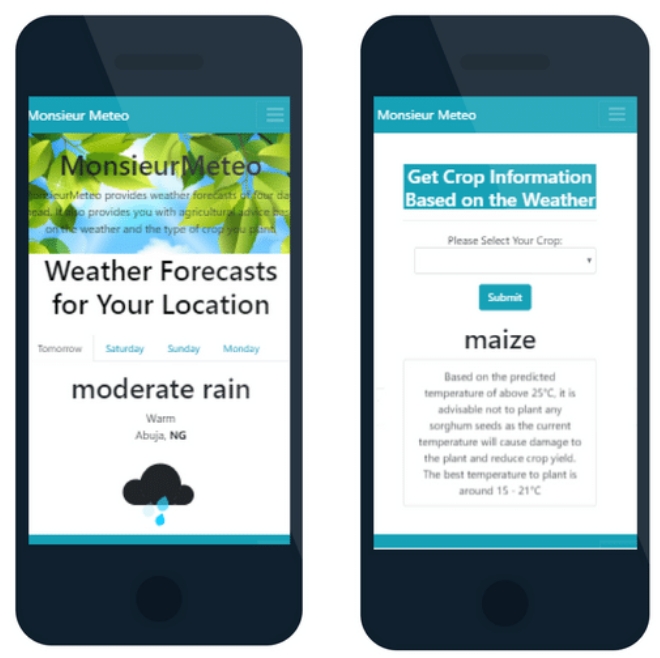
In the quest to improve the lives of farmers and improve agricultural productivity in rural Burkina Faso, meteorological data has been identified as one of the is key information needs for local farmers. Various online weather information services are available, but many are not tailored specifically to tis target user group. In a research case study, Hameedat Omoine designed a weather information system that collects not only weather but also related agricultural information and provides the farmers with this information to allow them to improve agricultural productivity and the livelihood of the people of rural Burkina Faso.

The research and design of the system was conducted at and in collaboration with 2CoolMonkeys, a Utrecht-based Open data and App-development company with expertise in ICT for Development (ICT4D).

Following the design science research methodology, Hameedat investigated the requirements for a weather information system, and the possible options for ensuring the sustainability of the system. Using a structured approach, she developed the application and evaluated it in the field with potential Burkinabe end users. The mobile interface of the application featured weather information and crop advice (seen in the  images above). A demonstration video is shown below

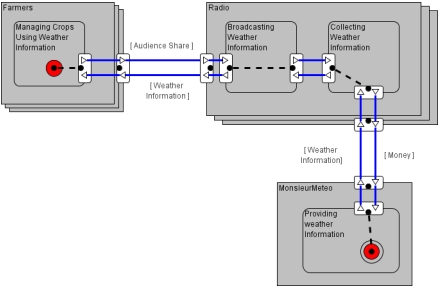
Hameedat developed multiple alternative models to investigate the sustainability of the application. For this she used the e3value approach and language. The image below shows a model for the case where a local radio station is involved.
Share This:

2nd TMT Workshop in Bamako

2016-05-10 13.14.35.jpg
Kasadaka as presented by AOPP

From 7-9 May 2016, the second TMT-AOPP workshop was held in Bamako, Mali. This workshop was held in the context of the Tailor Made Training project that VU Amsterdam participates in together with the Malinese farmer organization Association des Organisations Professionnelles Paysannes (AOPP).

During the workshop, which was attended by around 25 AOPP members from all over Mali, we followed up on the results of a previous workshop in 2015, where we co-developed a number of use cases around improving the lives of rural farmers in Mali. Specifically, we developed two prototypes services accessible using simple mobile phones:

  1. An online marketplace for seeds. Farmers can call in to the system to place offerings of seeds or browse current offers of seeds of various quality levels in a specific region.
  2. A chicken vaccination service. For this service, an extension worker can register newly born chickens in the system. The system keeps an administration of when farmers need to vaccinate their chickens against specific diseases. The system then calls the farmer and plays a reminder message in his/her language.

2016-05-08 12.03.55.jpgThese services were developed on Kasadaka, the cheap and low-resource rapid-prototyping platform for knowledge-rich and voice-accessible services. During the workshop we were able to further test the Kasadaka in the field. A field trip to local farmers and a milk cooperation in nearby Ouelessebougou gave us further context and information in how these services can support locals (see also the video embedded below). Chris van Aart from 2coolmonkeys demonstrated his progress on the Senepedia wiki and two Android applications that allow farmers and organizers to use geo-services to count cows, trees or other objects in the field.

2016-05-09 09.37.40
Chris van Aart shows his apps

In addition to these two services, we also presented seven services on the Kasadaka, developed by students of the VUA ICT4D M.Sc. course. These included a weather information service, two vetirenary services, general-purpose knowledge sharing platforms, farmer alert services and a milk market. These services were all very well received and allowed the workshop participants to really see the full potential of voice-enabled information services.

The presentation below shows more information, my personal highlights from the workshop (hence the title) as well as feedback received on the seven student projects.

https://www.youtube.com/watch?v=EAoXpvkdx5w


Share This: