Arcuno: a 3D-printable Knowledge Graph construction toolkit

[This post is partially based on Filippos Taprantzis Creative Technologies bachelor thesis and his amazing blog post]

As part of the VU-UTwente collaboration, VU Amsterdam now offers a bachelor program in Creative Technologies. This year, the first batch of students graduated with super nice and creative projects. I was happy to supervise one of these projects, by Filippos Taprantzis. Filippos developed Arcuno, a fully 3D-printable toolkit that can be used to arrange graph-like structures on a table. In particular, we focused on conceptual modeling (e.g. knowledge graphs, ontologies). One of the intentions of ArcUno is to enable a LEGO-building-like experience, which in turn can make the modeling task more intuitive and approachable.

Arcuno was accepted as a demo-paper at the 2026 SEMANTiCS conference in Ghent. In his blog post, Filippos details Arcuno, how it was presented at the conference, and why having 3-D printed components can actually save you when you forget to bring your actual demonstration material to the conference 🙂

From his blog:

“When Victor de Boer, my Graduation Project supervisor, initially proposed the idea of submitting the project to a conference, I could never have predicted that five months later, my friends Stijn, Nicky, Michela, and I would need to pull an all-nighter to remake the entire thing in under seven hours.

Before diving into the story, I would like to briefly describe what ArcUno, the project developed during my Creative Technology thesis, is and what problem it attempts to solve. “

read more at https://ftapr.com/rebuilding-arcuno-overnight

Arcuno github: https://github.com/robo-monk/ArcUno
Share This:

Developing a Sustainable Weather Information System in Rural Burkina Faso

[This post describes the Information Sciences Master Project of Hameedat Omoine and is based on her thesis.] 

In the quest to improve the lives of farmers and improve agricultural productivity in rural Burkina Faso, meteorological data has been identified as one of the is key information needs for local farmers. Various online weather information services are available, but many are not tailored specifically to tis target user group. In a research case study, Hameedat Omoine designed a weather information system that collects not only weather but also related agricultural information and provides the farmers with this information to allow them to improve agricultural productivity and the livelihood of the people of rural Burkina Faso.

The research and design of the system was conducted at and in collaboration with 2CoolMonkeys, a Utrecht-based Open data and App-development company with expertise in ICT for Development (ICT4D).

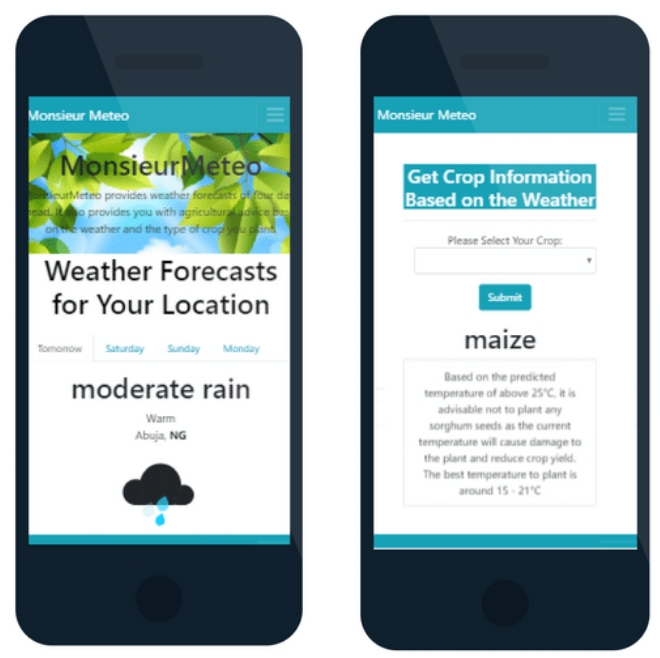
Following the design science research methodology, Hameedat investigated the requirements for a weather information system, and the possible options for ensuring the sustainability of the system. Using a structured approach, she developed the application and evaluated it in the field with potential Burkinabe end users. The mobile interface of the application featured weather information and crop advice (seen in the  images above). A demonstration video is shown below

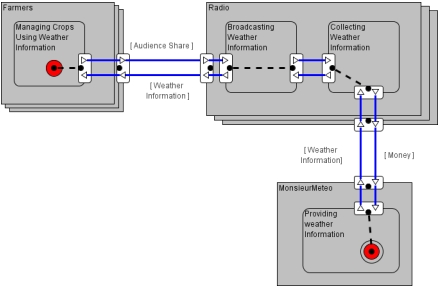
Hameedat developed multiple alternative models to investigate the sustainability of the application. For this she used the e3value approach and language. The image below shows a model for the case where a local radio station is involved.

Share This:

DIVE+ Submitted to LODLAM

Here’s the submission to the annual LODLAM challenge from the DIVE+ team. In this video, we introduce the ideas behind DIVE+ and take you for a exploratory swim in the linked media knowledge graph!

Share This: